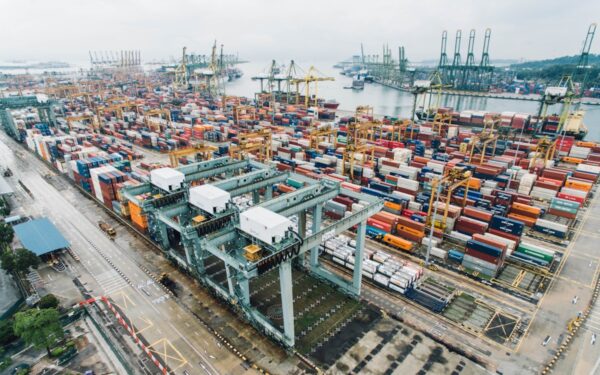
This morning’s briefing tracks how capacity moves, AI restructuring and energy constraints are colliding across global supply chains. Carriers are pricing peak season earlier, retailers are reshoring fulfillment, and power supply is starting to dictate where data and industry can grow. Here is what mattered in the last 24 hours.
Operations & 3PL
Marks & Spencer broke ground on a £340 million automated National Distribution Centre in Northamptonshire. The site will anchor the food supply chain and ease pressure on facilities running hot from volume growth. Construction is set to run for several years before commissioning. Source: Logistics Manager.
Canadian tea retailer DavidsTea is standing up US-based fulfillment after the end of the de minimis exemption. CEO Sarah Segal cited unpredictable delivery times and softer US sales as the trigger. The shift shows how mid-sized cross-border DTC brands are absorbing the cost of new customs rules. Source: Supply Chain Dive.
A US bankruptcy court approved STG Logistics’ reorganization plan, clearing the path to emergence. Funded debt will drop by more than $1 billion. A leaner balance sheet should let the drayage and contract logistics specialist refocus on core port-to-DC flows. Source: The Loadstar.
Japan Post’s near-20% stake in Logisteed, announced in October 2025, is finally moving toward operational integration with Toll Group’s Asia-Pacific network. The pace remains slow. Execution will decide whether the trio can offer a credible regional counterweight to the global 3PLs. Source: The Loadstar.
Technology & Automation
On the eve of Google I/O, Kristin White, transportation lead at Google, outlined a Gemini-powered robotics push aimed at freight, last-mile and mobility platforms. Gemini Robotics is positioned as a horizontal layer for physical AI. Expect concrete partnerships in the coming quarters. Source: DIGITIMES.
McKinsey’s Sarthak Vaish warned the Mobis Mobility Day audience that humanoid hardware is ready but the software stack is not. He flagged a growing “pilot purgatory” where buyers stall between proof of concept and rollout. The firm still pegs the robotics market at $400 billion by 2040. Source: DIGITIMES.
Reorganizations at Meta and Standard Chartered signal AI moving past productivity tooling. Both groups are rebuilding roles, workflows and reporting lines around AI agents. For supply chain leaders, the read-across is clear: operating model redesign now precedes the next wave of tech rollouts. Source: Logistics Viewpoints.
WiseTech Global joined the Digital Container Shipping Association’s DCSA+ partnership programme. The aim is faster adoption of open digital standards for booking, tracking and customs data exchange. Stronger software-side backing should accelerate end-to-end visibility across container chains. Source: Container News.
Sustainability & Energy
The proposed NextEra-Dominion combination would create the largest regulated US electric utility and a 130-GW large-load opportunity pipeline. The deal underlines a new reality: AI, data centers and electrification are turning electricity into a binding supply chain input. Power availability now sits alongside chips and ocean capacity in board-level risk reviews. Source: Logistics Viewpoints.
Hong Kong should accelerate hydrogen adoption to hit its carbon neutrality target, according to advisors quoted by SCMP. Priority use cases include heavy vehicle refuelling at container terminals and industrial zones. Without a hydrogen layer, the city risks missing its 2050 goal. Source: SCMP.
Hapag-Lloyd introduced and adjusted an Emergency Fuel Surcharge on inland rail and combined rail services in Australia, citing fuel cost volatility. Shippers moving containers off-port via rail should expect higher landed costs on intra-Australia legs. Source: Container News.
International Markets
The 2026 National Freight Strategic Plan reframes freight as a national operating system rather than infrastructure plumbing. Resilience, energy security and industrial competitiveness anchor the document. It also signals tighter alignment between USDOT, energy policy and supply chain resilience funding. Source: Logistics Viewpoints.
Maersk confirmed new Peak Season Surcharges on Asia-North America, Asia-Canada and Asia-East Africa lanes. The early notice points to a tighter capacity outlook into Q3. Beneficial cargo owners should refresh budget assumptions on peak-season rates now. Source: Container News.
Westbound transatlantic capacity is settling after a turbulent first quarter. The Loadstar attributes the swings to capacity injections that were quickly reversed. Spot rates have stabilized, though carriers show little appetite for sustained price cuts. Source: The Loadstar.
Cargo theft volumes fell in Q1, but the mix shifted toward fraud-based attacks, according to Overhaul. Deceptive pickup scams climbed sharply. The takeaway for security teams: physical hardening still pays, and the next dollar belongs to identity and verification at the booking layer. Source: American Shipper.
Related Coverage
- Amazon Opens Logistics Network to Outside Brands With New Supply Chain Arm
- Zebra Ventures Backs Canadian Physical-AI Specialist Apera AI
- Weetabix Extends UK Warehousing Partnership With XPO Logistics
- EPG and Locus Robotics Team Up on WMS-Driven AMR Integration
Updated daily — your morning briefing on global supply chain.